

Winnie-the-Pooh at 100 – Wisdom from the Forest
How to Leverage People Power in the Real World
– Steven Covey
Summary: The cultural competencies of Christopher Robin, Pooh, and the gang are indeed enduring: trust, loyalty, comradery, respect, patience, love, joy, willingness to listen and care, ingenuity in times of crisis and uncertainty, and dedication. Isn’t it remarkable that the Chief Executive Roundtable came to this same conclusion as Milne’s World of Pooh in which technology consisted of things found in the forest! After one hundred years of transformational innovations, the most important transformation for success is cultural.
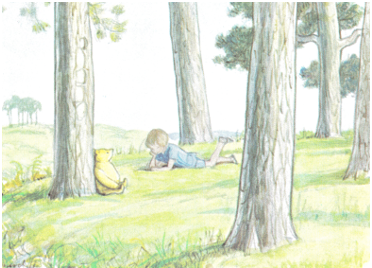
Christopher Robin and Winne the Pooh, E.H. Shepard, Illustrator
Imagine, three generations have loved the stories of A. A. Milne! How can any child or adult for that matter, resist the adventures of Christopher Robin and his motley menagerie? Well, menagerie may be unfair as Christopher’s animal friends were neither wild nor foreign, but they were certainly unique and in exhibition for the whole world to observe. While just a boy, Christopher was the leader of his team of animated stuffed animals. There was Pooh Bear, of course, Piglet, Tigger, Kanga and Roo, Rabbit, Owl, and last but not least, Eeyore the donkey. They went on many adventures in the Enchanted Forest filled with challenges, dangers, imaginary or not, fun, and sometimes work. Christopher was very good at balancing fun and work, a perfect team leader by any measure.
Christopher’s Team
Each character had a distinct personality with strengths and weaknesses, and all were lovingly loyal to Christopher. Pooh was his favorite, of course, a bear with a very little brain but an immense heart not only for Christopher but the whole gang. Fearfully timid Piglet was Pooh’s favorite; while in awe of Pooh, Piglet was oblivious of his limitations,. Tigger entered later in the compendium of stories but was an unforgettable character with a lot of enthusiasm in his irrepressible bounce. Kanga was mother to inquisitive Roo, always looking after her baby kangaroo, like any mother would. Inclusive Rabbit was the practical one on the team, thoughtfully watchful for the forest’s pitfalls! Owl was resiliently reflective and always shared a word of wisdom. While Eeyore had no lack of sympathy, mostly for himself, he tended to be gloomy and skeptical yet dared to be helpful whenever he could.
Team Dynamics
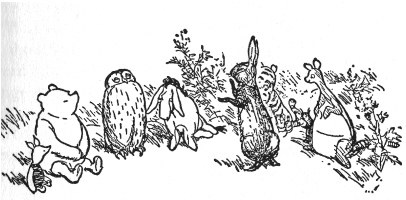
Planning meeting to honor Christopher Robin, E.H. Shepard, Illustrator
Each of Milne’s characters has something to which people can relate, and the memories of growing up with Winnie-the-Pooh remain vivid for every fortunate child who explored the forest alongside Christopher Robin and friends. There are certainly many lessons embedded in those imaginative, yet surprisingly realistic, adventures with lessons that remain relevant to our lives as adults, both at work and play. The wisdom of Milne’s forest characters is in the value of every person as part of the team. He elevated emotional intelligence over raw intellect, the heart over strategy, imagination over logic.
The forest was not a perfect world, but it was memorable indeed! In the end, Christopher grew up and had to leave the forest. His friends did not know where he was going, only that they would miss him.
Milne cannot bear to have Christopher say goodbye to Pooh, so the book ends with Christopher Robin saying, “Come on!” “Where?” says Pooh. “Anywhere,” responds Christopher Robin. Milne optimistically declares, “Whatever happens to them on the way, in that enchanted place on top of the forest, a little boy and his Bear will always be playing.”1
Application to the Real World
If every team were as trustworthy and cooperative as Christopher Robin’s, organizations would prosper, grow, innovate, and thrive. To come close to the success of this enduring team, organizations must strive to elevate the heart and relational aspects of leadership and the team, just as Milne does. In today’s world of AI disruption, accelerating change, and global competition, organizations must not forget that it is people who set the vision and goals, harness the capabilities of technology, and implement adaptations to succeed.
The 2025 Chief Executive Roundtable discussed the importance of trust in an age of AI and geopolitical volatility. Steven Covey, author of Speed of Trust, shared the importance of counteracting distrust with the right actions and words: “Trust is learned as a skill; it’s a competency.” CEOs shared their experiences in demonstrating vulnerability and transparency, listening, caring about their employees, building authentic connections, engaging employees in AI adaptations to make their work and environment better, investing in employees and teams, and facilitating talent potential as ways to build trust.
These CEOs recognized that they cannot control chaos outside the organization, but that there is a competitive advantage to control and limit chaos within the organization by building trust and creating cultures focused on transparency and collective success. Covey reinforced, “Start with our own people, our own team, our own culture. We can become a model of what’s possible or a better way to lead, where we get results in a way that inspires trust. It’s an inside-out process. That’s how a change will happen.2”
Leverage “Pooh” Power with Predictive People Analytics
The cultural competencies of Christopher Robin, Pooh, and the gang are indeed enduring: trust, loyalty, comradery, respect, patience, love, joy, willingness to listen and care, ingenuity in times of crisis and uncertainty, and dedication. Isn’t it remarkable that the Chief Executive Roundtable came to this same conclusion as Milne’s World of Pooh in which technology consisted of things found in the forest! After one hundred years of transformational innovations, the most important transformation for success is cultural.
In going from the fantasy forest to our complex world, we can leverage “Pooh” or “people-oriented” competencies through the application of predictive behavioral assessment and analytics. By measuring the strengths and areas of development for each person and team member, organizations can more readily develop and utilize these vital talent and leadership competencies.
— Mark Linenberger, EVP,
Linbeck Group & President, AMS
Harrison Assessments comprehensive predictive behavioral assessment system facilitates this development. Measuring 175 traits, factors and competencies, Harrison Assessments can be applied across the talent cycle for hiring, development of leaders and teams, engagement, succession planning, career development, and more. Harrison’s Organizational Analytics facilitates analysis of the needs and risks of teams, groups, or individuals, and provides solutions for engagement, retention, talent management, leadership and organizational development, and cultural enhancement. One might think that such a wide range of capabilities seems as fanciful as Milne’s forest! Yet, Harrison Assessments’ predictive measurements and proven solutions are as real world as it gets. If you embrace innovation, leading edge analytics solutions, and the power of people, then Harrison Assessments is right for you and your organization. If Milne were writing in the present day, one could envision Christopher Robin engaging in innovative adventures involving artificial intelligence with Pooh and his friends, while still preserving the characters’ enduring values.
By Sheryl Dawson
CEO Dawson Consulting Group
 .
.
